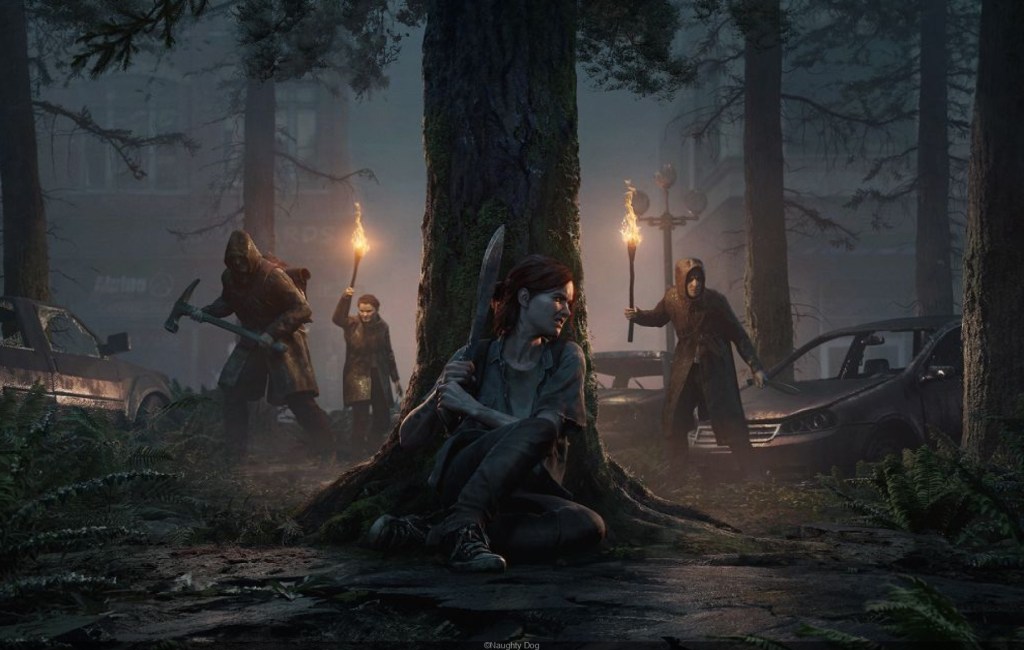
Originally released in 2013, The Last of Us is an action/adventure themed video game programmed for Playstation consoles. The renowned story was recently translated into a television show in early 2023 and provided a new context to the narrative. Although the plot is fictional, visibly seeing humans play as the characters added another level to the plausibility of the dystopian circumstances in real-world factors. Taking place in post-apocalyptic America, a nuanced setting allows the player to engage and participate in multifarious variations of hermeneutics. Throughout the duration of our Power and Influence course, our class discussed how each behavior and practice we mimic is construed from another individual or form of media. Despite being a seemingly free-reign world, the leadership and governmental structures within the locations of The Last of Us can be discerned as those that presently occur in “our” world.
The Last of Us depicts the story of survivors Joel and Ellie as they work together to survive a westward journey to Salt Lake City in pursuit of creating a cure for the fungal pandemic that fractured humanity. After discovering fourteen year old Ellie is Immune, Marlene, the leader of The Fireflies, assigns Joel a task to escort her to another Firefly base in hopes that doctors can fabricate a reverse engineered vaccine through her condition. Joel leads Ellie “out of a militarized Quarantine Zone in Boston and across the cauterized wasteland of post-apocalypse America.” (Jacobson, 2023)
Naughty Dog, the developers of The Last of Us, dispersed a controversial ending of the story. “In the final version, Joel takes Ellie to a lab where doctors will attempt to create an antidote using her immunity as the source. But he learns that in order to create the antidote, Ellie must die — and his parental instincts kick in. Players are forced to kill anyone that gets in Joel’s way during his rescue attempt, essentially saving Ellie at the expense of the world,” Webster states. (Webster, 2013)
Although no governmental structures are warranted upon survivors, some have found a sense of community and safety within factions that have manifested in the post-outbreak social culture. It can be deduced that there are many unknown forms of leadership through The Last of Us universe, as the sequel of the game introduced us to new military and administrative groups. The main agencies of power within the game are Fedra, The Fireflies, The WLF, and Seraphites.
The Federal Disaster Response Agency (Fedra), the only remaining branch of the U.S. government, and The Fireflies are the only nationally recognized militia groups in The Last of Us. Both groups were in a constant state of conflict and resisted one anothers ideologies. As a result, each faction frequently attacks the others bases, as The Fireflies find Fedra’s practices exploitative and antagonistic, while Fedra fights back to prevent further fatalities. The Fireflies are stationed throughout the U.S. performing biomedical research in pursuit of a cure for the cordyceps infection. “FEDRA was a government agency in the United States, tasked with responding to disasters and managing emergencies. After the initial Cordyceps brain infection outbreak, FEDRA seized control of the U.S. government and armed forces in order to set up the quarantine zones. Becoming amalgamated with one another in the process, they imposed martial law and dissolved the other organs of state. In the QZs, soldiers prevented citizens from leaving the city, subjected them to forced labor, and when supplies were low, restricted basic food rations. They often executed dissidents and criminals, or expelled them from the QZ.” (N.d, 2024) Dissecting this, we can infer that Fedra was deemed as the most qualified branch of government to lead major cities, but over time confiscated all culture and colloquialisms within each community. An intriguing note within the militia group is that there is not one cloistered leader who dictates which decisions are made, whereas the WLF, Seraphites, and Fireflies collectively have a valorized leader.
From these narrative structures, we observe the clear power structures that Fedra aims to impose on citizens. Residents who live in quarantine zones are treated unfairly under the influence of Fedra soldiers and the numerous leaders of the militia group; unethical amounts of “ration cards” are distributed to citizens and have replaced the U.S. dollar as currency. Labor is performed in exchange for the cards, which can purchase food and other necessary resources. People surrender themselves under Fedra for safety despite the disputatious paradigms of the group’s tactics.
The Last of Us clearly illustrates the structural power between the military and leaders against the citizens. The higher ups eat well and sleep comfortably, whereas citizens are given the bare minimum to survive and are forced to work undesirable, gruesome jobs. As an agency, members are aware they can negatively utilize their power to subsidize the citizens to their liking. Fedra has a transactional relationship with the citizens who reside in quarantine zones. Survivors are granted safety by Fedra soldiers and meals on the table in exchange for toilsome labor.
The Washington Liberation Front (WLF) is a group of “leftover” Fireflies remaining from the catastrophe in Salt Lake City towards the end of the first adaptation and led by Isaac Dixon. Originally under Fedra’s control in the Seattle quarantine zone, he rose to power after being the only remaining member of the rebellion group and was democratically voted to lead the WLF. As the WLF grew as an organization, they became xenophobic and began to only trust each other, resulting in hostile behavior towards outsiders. This ruthlessness manifested in a growing conflict with a large segment of survivors who lived in Seattle who previously fled the suburbs to live on a local island. The WLF considered the group a death cult. “In time, their hostilities escalated into full-blown violence when the Scar leader, known only as The Prophet, bombed a WLF supply platoon, destroying their trucks and killing several soldiers.” (N.d, 2024) This catastrophic event inaugurated the beginning of the war between the WLF and Scars, the name by which they address Seraphites. Similarly to Ellie’s vengeance in the second game, the cycle of violence perpetuates the message of the sequel: conflict will continue unless agreement is found between the group’s particulars and universals. The WLF’s universal need for communal security aligns with The Seraphites, but have vastly opposing particulars. Focused on religion and protection in “The Prophet,” the Seraphites’ interests differ from the WLF, whose primary focus is rebelling against Fedra.
One of the primary assignments in my Power and Influence course was to analyze practices and patterns in stories. From our research, our class noted how after dissecting components of stories, we can start to see the intentionality and symbolisms within the body of a narrative. I was particularly interested in the etymology of the term “Seraphite.” After some research, it was discovered that “Seraph” is translated to “Burning” in Hebrew. If we look to Latin derivatives, “Sera” means “Late” and “Phyte” is construed as “Plant.” (N.d., 2024) Although there is no specific clarification on the semiotics of The Seraphites title origination, a connection can be made from the frequent use of fire as a symbol within the games plot.
In our class meetings throughout the semester, we discussed the intrinsic interpellation of the anatomy of narrative that permits us to coincide with aligning our personal ideologies into the structures a story illustrates. A player can be influenced by either side of humanity’s reaction to the outbreak: finding security in controlled practices and accepting the circumstances as they are, striving to change the social construct, or completely rejecting any outside groups. However, games additionally permit us to explore choices that do not necessarily align with our values due to the lack of physical consequences.
Deviance does not exist in the conceptualizations of The Last of Us universe. That is, except for the agencies that survivors’ willingly participate in. The game naturally places the player in a position to morally rank the systemic amalgamations that are provided to us, which is dictated by the mannerisms they were exposed to. You are immersed into the post-apocalyptic configurations by playing in third-person, but still separated from the dichotomy of the first-player/character relationships. Nonetheless, the player is permitted to put themselves in Joel’s shoes by visibly seeing his character through gameplay. “The third-person shooter is a great vessel for simulating the experience of surviving a zombie apocalypse, and for telling the story of a character dealing with emotional trauma and interpersonal relationships. The gameplay design of emphasizing combat by creating a collection loop emphasizes the foraging lifestyle Joel would be living, and also presents us with an opportunity to have to share supplies among you and your allies (though this is never taken advantage of).” (Savant, 2023) The author accurately demonstrates how the player is influenced by the immersion of the post apocalyptic environment; forcing them to impersonate the behavior of a human who truly was required to be frugal with resources.
Discussing the examples of leadership and rise to power in The Last of Us is quintessential to understanding how such events occur in real life. What’s interesting about how leaders gain power in the game’s narrative is that it happens purely organically and not based on any party system; it is exclusively because citizens make the conscious decision to be influenced and led by them. Like any social group, there will always be people who are more aligned with the values of the agency. Particulars are the specific ways a culture practices a universal trait (Lowe, 2015) In our reality, we don’t have a choice in whether or not we want to be a participant in the bureaucratic dialects in our country (unless we move countries.) However, in the story’s setting, no laws are established where influence is held. Survivors in The Last of Us simply chose whether or not to participate in the cultural and social practices of a certain group.
The only example where this is not directly applicable are the schools run by Fedra. Orphans are sent to Fedra and trained to be soldiers. The U.S. education system prepares children for the structure of a workforce, and Fedra translated this to acclimate suitable people for the same construct. The conflict prevalent in this dichotomy is that the leaders in Fedra ultimately hold power in deciding the fate of each citizen, which more often than not are grueling, disreputable occupations.
“In the face of real pandemics, war and climate crisis, there is widespread perplexity about how to understand the scale of these runaway emergencies and about how to formulate credible answers to them.” (Jacobson, 2023) Jacobson proposes a notable connection between Fedra’s structure; citizens will perpetually be frustrated with the outcomes a government structure provides, even if the agency themselves is strategically planning the most adequate way of executing so. The leaders of an organization are required to curate decisions that benefit the whole. In a world where resources are scarce, leaders have to be parsimonious in regard to materials to ensure each citizen can survive.
Particulars and universals are concretely evident in the narrative’s setting. In class, we discussed how finding congruence between particulars and universals mitigates conflict. Universals internationally recognized through culture are religion, shelter, food, language, family units, and warfare. (Lowe, 2015) In The Last of Us, there has been a loss of culture within most social groups as people are more prioritized on security and safety rather than celebrating tradition. Each faction group has a series of particulars that measure success.

The themes of The Last of Us I and II contrast quite differently. In the first game, the main consensus is finding light and purpose in a broken world which consistently remains in a pandemonium. The Last of Us II pertains more to the cycle of revenge. Both games exemplify how power is malleable and under the circumstances of the outbreak, has either led people to yearning for leadership, or simply avoiding organizations all together.
A recent study was conducted to deduce the effects of removing agency from the character/player dynamic, particularly in conjunction with The Last of Us Part II. Halfway through the long-awaited sequel, a player is impelled to play as Abby, a generally disliked character as a result of her taking Joel’s life. The research elaborates on the willingness of a player to change their image of a playable character will be dependent on the level a player projects their own ideologies within the game and how much they are reciprocal to proactively generating interpretations of the various characters. (Erb, V., Lee, S., & Doh, Y. Y., 2021).
From this, we can conclude that fans of the original game are only able to build a neutral or positive opinion towards Abby by imposing their own ideologies and experiences as they play as her character. Preconceived notions are evident through a player of the sequel as attachments are naturally made towards the original characters, Joel and Ellie. Naughty Dog intentionally orchestrated the trajectory of the game to construct resentment towards Abby’s character by the time we play as her. The creators minimizing agency from the player influences the individual to see both sides of the conflict and come to the realization that they are fighting over the same cause. Throughout the Power and Influence course, the class considered how the audience of a story becomes connected to characters who acquire qualities we share or yearn to be. The developers of the sequel invite the player to be influenced by engaging with Abby and The WLF to understand their practices.
2013, despite being only eleven years ago, was a very different world in terms of technology. As new devices and applications are created, society reacts to the events as a culture that ultimately shapes us. Neil Druckman, the director of the game, began developing The Last of Us in 2009. Major events that occurred in 2009 that may have influenced the story were the first case of swine flu in the U.S and the release of James Cameron’s Avatar, which explores the cycle of violence and risk/reward configurations. (N.d, 2023)
The purpose of storytelling is to interpret messages and the semiotics a narrative conveys. Additionally, story is utilized to facilitate change. The Last of Us’s story in particular has a type of cajolery that invites the player to compare our world to a fictional world of despair and corrupted power structures. Frenetic behavior is no longer deemed as deviance in the social setting as a result of the requirement to defend one’s life without any legal consequences. All rules in The Last of Us universe are practiced by choice, not because refusing to do so would lead to legal discrepancies. Infected individuals are the perfect example of this; the victims of the cordyceps virus are still humans. Yet, the players and characters themselves are influenced more by the non-infected enemies. Because the cordyceps fungus has a permanent measure of power over its host, we intrinsically situate ourselves in the position of Joel and Ellie as we observe their relationship’s growth. This results in performing whatever it takes to protect the characters’ from harm.
An additional theme we’ve discussed throughout our class this semester is the idea that all stories are inspired by some aspect of real-life instances. Humans typically are not able to see what they have not experienced, and The Last of Us offers perspective on how humanity would potentially react to a world of distrust, betrayal, and survival. For example, a parent may respect Joel’s decision to withdraw the potential of a cure for the virus in order to save Ellie, while those who are not may perceive his choice as selfish. A common theme within post-apocalyptic entertainment is the focus being on the effects an outbreak has on humanity. People enjoy the game for the mixture of unfamiliarity and familiarity of a dystopian society.
Power has the ability to be translated through numerous styles of media and mimics behavior from real world behaviors. Storytelling is a practice exclusive to humans, and we create narratives derived from ideas or events expressed to us or that have been experienced by the individual themselves. The Last of Us is a story that contains many branches of discussion, but delineates practices of power, war, and conflict represented in historical events. All people participate in social groups and cultures, some are fabricated by choice and others we are born into. The Last of Us exemplifies the cultural practice of the human desire to belong to a designated group and look for structured security, whether that is as a leader or a follower.
Resources:
Savant, N. (2023, December 9). Story analysis – part 1 – Last of Us. Game Developer. https://www.gamedeveloper.com/design/story-analysis—part-1—last-of-us
Contributors to The Last of Us Wiki. (n.d.). Federal disaster response agency. The Last of Us Wiki. https://thelastofus.fandom.com/wiki/Federal_Disaster_Response_Agency
Jacobson, G. (2023, February 3). Consolations of apocalypse: The Last of Us reveals how we seek mindless comfort in dystopia. New Statesman, 152(5702), 32+. https://link-gale-com.immaculata.idm.oclc.org:9443/apps/doc/A738753205/PPOP?u=pl5362&sid=bookmark-PPOP&xid=b1e3e2f5
YouTube. (2015, November 18). Universals vs particulars. YouTube. https://www.youtube.com/watch?v=xWcaLZKVEfA
Webster, A. (2013, September 19). The power of failure: Making “the last of us.” The Verge. https://www.theverge.com/2013/9/19/4744008/making-the-last-of-us-ps3
2009: Facts & Events that happened in this year. The Fact Site. (2023, December 30). https://www.thefactsite.com/year/2009/
Contributors to The Last of Us Wiki. (n.d.-b). Washington Liberation Front. The Last of Us Wiki. https://thelastofus.fandom.com/wiki/Washington_Liberation_Front
Erb, V., Lee, S., & Doh, Y. Y. (2021). Player-character relationship and game satisfaction in narrative game: Focus on player experience of character switch in The Last of Us Part II. Frontiers in Psychology, 12. https://doi-org.immaculata.idm.oclc.org:9443/10.3389/fpsyg.2021.709926
Wikimedia Foundation. (2024, May 2). Seraph. Wikipedia. https://en.wikipedia.org/wiki/Seraph#:~:text=In%20Hebrew%2C%20the%20word%20saraph,in%20the%20Book%20of%20Isaiah.
 Where The Wind Takes Me.